Buying a first wheelchair is rarely a calm decision.
It usually follows a fall, a hospital stay, or a slow realization that a parent is avoiding outings because walking has become too tiring.
Families end up comparing products they have never needed before, using terms they have never had to learn.
This guide is meant to make that easier.
It explains what to decide first, what to measure, which features matter most in a wheelchair for senior citizens, and how our own range at JCBL Mobility fits different situations.
We have written it the way we would explain it to a family calling us for the first time.
Start With One Question : How Much Is The Person Walking Today?
Before looking at any product, answer this plainly, because it changes the right choice completely.
● Not walking at all, or only a few steps with a lot of help: a full-time wheelchair is the starting point.
● Walking with support but tiring quickly: a walker with a built-in seat may suit better than a full wheelchair.
● Walking fine at home but struggling on trips, outings, or long distances: a lightweight travel wheelchair may be enough.
● Fine on flat ground but unable to manage stairs: the problem is the staircase, not the wheelchair.
Many families buy a standard wheelchair for elderly relatives when the real need is a different product. Matching the product to the actual situation avoids paying for the wrong thing.
The Main Types Of Wheelchair For Elderly People
Everyday Folding Wheelchair
A folding wheelchair is the most common choice for regular mobility support. It is used at home, on outings, and in the car. Look for a strong frame, comfortable seating, brakes the caregiver can reach, and a fold that one person can manage.
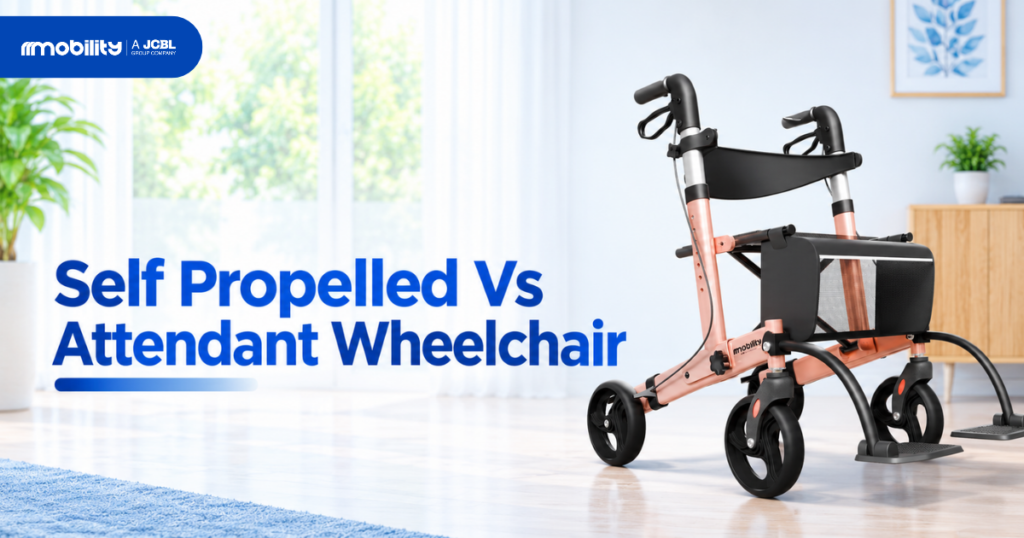
Convertible Walker And Wheelchair
For someone who can still walk with support but needs to sit down without warning, a convertible product removes the need to switch between two separate pieces of equipment. It works as a walking aid first and a wheeled seat when needed.
Travel Wheelchair
A travel wheelchair prioritises low weight, a compact fold, and features like good braking for ramps.
It suits people who mainly need mobility help on trips, at airports, and during long outings.
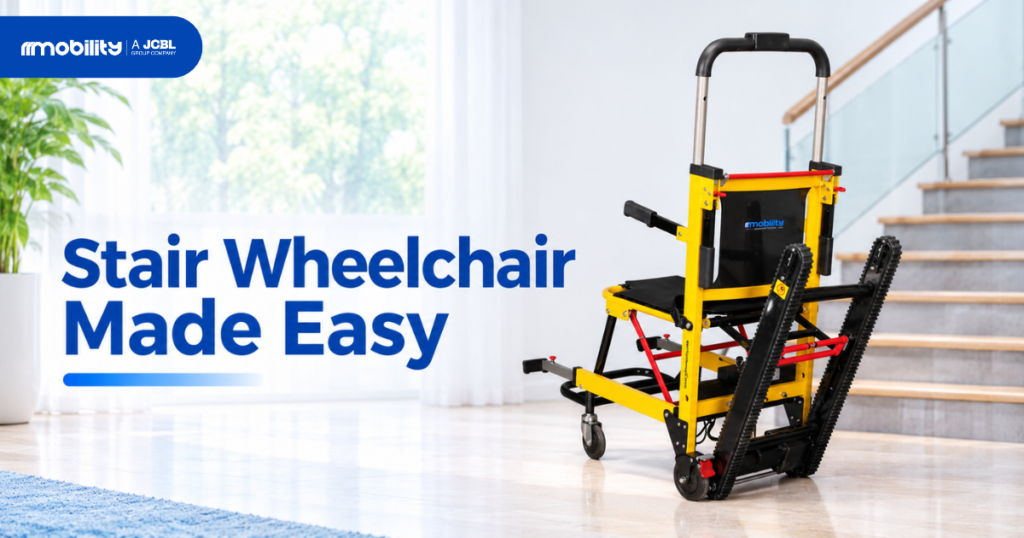
Stair-Climbing Wheelchair
If stairs without a lift are the main obstacle, a standard wheelchair will not solve it. A stair-climbing chair is built for that one problem.
What To Measure Before You Buy
Good fit matters more than most people expect. A wheelchair that is too narrow causes pressure and discomfort. One that is too wide makes pushing and posture harder. Measure these before you compare products :
● Hip width while seated, to check the seat width
● Seat depth, from the back of the hips to the back of the knee
● Leg length, to set footrest height correctly
● Weight of the person, and whether there is a safe margin below the chair’s maximum
● Width of your doorways, bathroom entrance, and any narrow passage the chair must pass through
● Space for turning in the bedroom and bathroom
Write the numbers down and take them with you when you speak to any supplier. A reputable seller will want them.
The Features That Matter Most In A Wheelchair For Mobility Assistance
Frame Strength And Weight Capacity
The frame carries daily load, so strength matters. Our AeroChair and GlideX use high-carbon steel frames, and AeroWalk uses an aluminium alloy frame rated for 120 kg.
GlideX is also rated for 120 kg. Whatever product you choose, confirm the weight rating and leave a margin above the user’s current weight, since weight can change over time.
Brakes
Hand brakes on the push handles give a caregiver control on slopes, ramps, and kerbs.
This is a safety feature worth checking in any product. GlideX goes further with a dual hand braking system that manages uphill and downhill sections separately.
Seating Comfort
Older users often sit for long periods. Breathable fabric or mesh keeps the seat comfortable and reduces heat build-up.
Padding and good posture support matter more for full-time users.
Armrests And Footrests
Flip-up armrests make side transfers into a car seat or onto a bed much easier.
Footrests should support the legs at the right height, so they are not left hanging.
Wheels
Large rear wheels roll smoothly, and smaller front swivel wheels help with tight turns in hallways and rooms.
TPU wheels are used across our range for smooth, stable movement on tiles and pavements.
Folding And Storage
If the chair goes in a car boot, the fold needs to be quick and the folded size manageable.
AeroChair folds down completely, and AeroWalk and GlideX fold into three parts with a single key.
How JCBL Mobility’s Wheelchair Range Fits Different Situations
● AeroChair is our foldable wheelchair for regular or full-time use, with a high-carbon steel frame, mesh seating, flip-up armrests, and hand brakes on the rear push handles.
● AeroWalk is our convertible walker cum wheelchair, for people who can still walk with support but tire quickly. It has an aluminium alloy frame rated for 120 kg and height adjustment. GlideX is our travel-focused model, with a high-carbon steel frame, dual hand braking, a built-in storage bag, and a 120 kg rating.
● Step Up is our stair-climbing wheelchair, supporting up to 125 kg and stair angles up to 35 degrees, with up to 500 steps on a full charge. Many families use more than one. For example, a person might use AeroChair daily and GlideX for travel.
Common Mistakes First-Time Buyers Make
● Buying a bulky wheelchair that cannot be lifted into the car easily
● Skipping measurements and discovering the chair does not fit through a doorway
● Choosing a wheelchair when the real problem is stairs or car entry
● Leaving the senior out of the decision, then finding it goes unused
● Ignoring after-sales support and servicing
● Buying for today’s need and not thinking about how needs may change
Involve The Person Who Will Use It
A wheelchair can feel like a loss of independence to the person using it.
Comfort, appearance, and a sense of choice all affect whether it actually gets used.
Let them sit in it, try the brakes, and say what feels right.
A Note On Medical Advice
A wheelchair supports mobility, but it does not replace medical guidance.
If the person has balance problems, pressure sore risk, or a condition that affects sitting posture, ask their doctor or physiotherapist about the right seating before you buy.
Our Quick Recommendation
Begin with how much the person walks now, measure their body and your home, and choose the lightest, simplest product that meets that need safely.
If you are unsure, tell our team about the person’s mobility, your home, and how the chair will be used, and we will help you match it to the right model rather than the most expensive one.