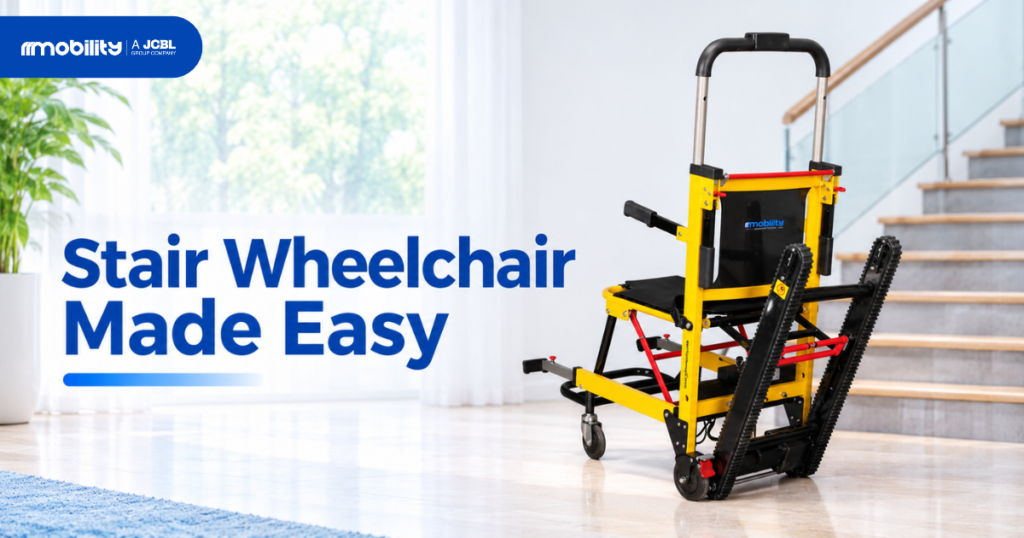
For many families, the staircase is the one obstacle a regular wheelchair cannot cross.
A person can move comfortably around the ground floor, then find the bedroom, a family room, or a terrace completely out of reach.
Carrying someone up the stairs is risky for everyone involved, and a lift is not always possible in an older home or building.
A stair wheelchair is designed for this problem.
This guide explains how it works, who it helps, how it compares with other options, and what to check at home before you buy.
We use our own Step Up as the example and stay with its published specifications.
What Is A Stair Wheelchair?
A stair wheelchair, also called a staircase wheelchair, a wheelchair stair assist, or a mobility chair for stairs, is a chair that carries a seated person up and down a staircase using a powered mechanism, so nobody has to lift the person. On flat ground it moves like a wheelchair.
You may also see it called a wheelchair staircase climber or a stair climbing chair. These all describe the same idea.
How A Stair Wheelchair Works
Step Up works as a manual wheelchair on flat surfaces. When it reaches a staircase, it switches to a battery-powered stair-climbing system that carries the chair and the person up or down step by step. The climbing effort comes from the battery, not from a caregiver’s arms and back.
Its published specifications :
- Supports users up to 125 kg
- Handles stair angles up to 35 degrees
- Climbs up to 500 steps on a full charge
- Charges in approximately 3 to 4 hours
- Designed for indoor and outdoor use
- Advanced safety locks and stable stair-grip technology
- Comes with the chair, a power charger, and a user manual, and does not need major installation
Who Does A Stair Wheelchair Help?
Families usually come to us in one of these situations :
- An older parent living in a home or building with no lift, who has stopped using the upper floor
- Someone recovering from surgery or an injury who cannot manage stairs yet
- A person with long-term mobility limits who lives in a multi-storey home
- A caregiver who has been helping on the stairs and is worried about their own back
- A family who wants to visit relatives who live up a flight of stairs
The common thread is that the staircase, not the person’s general mobility, is the main barrier. If that is the case, a stair wheelchair is worth considering.
When It Is Not The Right Answer
A stair wheelchair is not an everyday wheelchair replacement for every situation. If stairs are not the problem, a regular foldable wheelchair or a transfer chair may suit better. And if the staircase has features outside the chair’s design, such as unusual curves, it may not be suitable.
How It Compares With Other Options
- Ramp: Works well for low heights, but stairs usually need a long, gentle ramp, which most homes cannot fit.
- Stairlift: A fixed rail installed along the staircase. It suits permanent installations on straight or curved stairs, but it needs installation and works only on that staircase.
- Home lift: Gives full access but is a major construction project.
- Stair wheelchair: Portable, needs no installation, and can be used on different staircases, such as at a relative’s home.
The right choice depends on your budget, building, and whether you need access in one place or several.
What To Check At Home Before You Buy
Measure The Stair Angle
Measure the rise (the height of one step) and the going (the depth of one step). The angle is the inverse tangent of rise divided by going. For example, a rise of 17 cm and a going of 25 cm gives about 34 degrees. Step Up is rated up to 35 degrees.
Count The Steps
Count the steps you would climb in a day, up and down, and compare the total with the stated range of up to 500 steps per charge. Leave a margin.
Check Width And Headroom
Measure the staircase width, and the doorways at the top and bottom. Check headroom, especially at turns and under low ceilings.
Look At Landings And Turns
Straight staircases are simpler. Note any landings, turns, or curves. The Step Up product page does not specify staircase types such as spiral or curved, so if your staircase has sharp turns or curves, send us photos and measurements before you order.
Check The Step Surface And Railings
Worn, uneven, or slippery steps affect grip. A sturdy railing gives extra safety.
Plan Where The Chair Will Live
You need floor space at the top and bottom of the stairs to position the chair, and somewhere to charge and store it.
Safety And Use
We recommend a caregiver stays nearby during use, especially in the first weeks. Learn the controls on a flat surface before using them on stairs, and keep the belt clean and the battery charged. Step Up should be charged at least once every two months, even with light use.
A Note On Medical Advice
A stair wheelchair makes staircases safer to navigate, but it does not replace medical advice. If you are unsure about the person’s balance or ability to sit safely during the climb, ask their doctor or physiotherapist.
Our Recommendation
Start with the staircase. Measure the angle, count the steps, and note the turns. Then compare those numbers with the chair’s rating.
If you would like us to check whether Step Up fits your home, send your measurements and a few photos and we will tell you plainly whether it is the right fit.