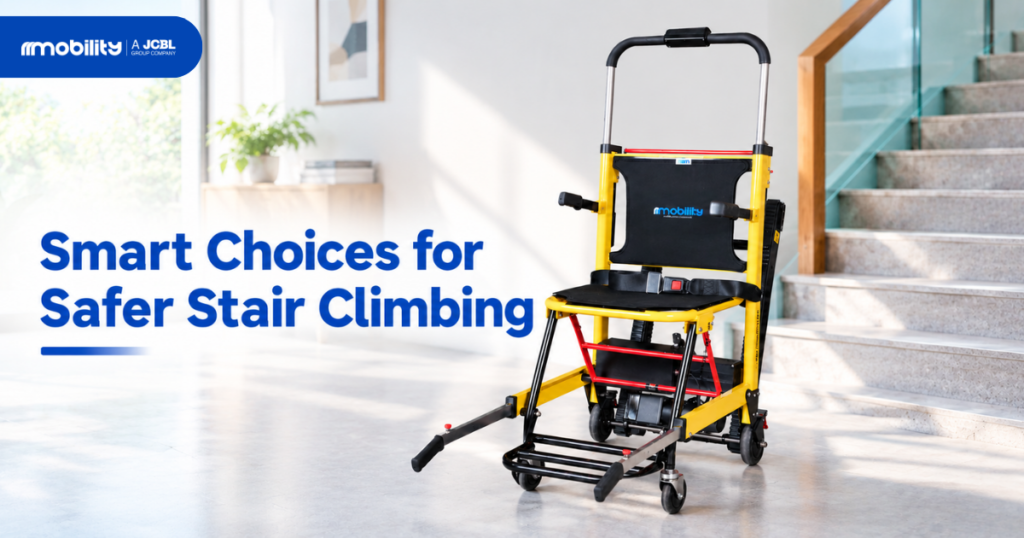
A stair climbing chair solves one of the hardest problems in home mobility : getting a person up and down a staircase when there is no lift and carrying them is not safe.
It is also a purchase where small details decide everything.
A chair that suits one staircase can be the wrong fit for the next, and the features that matter are not always the ones that get the most attention in a product listing.
This guide walks through what to check before you buy : the safety features to ask about, how to think about battery range, and how to assess your own staircase.
We use our own product, Step Up, as the worked example, and we stick to its published specifications.
What A Stair Climbing Chair Does
A stair climbing chair, sometimes called a stair climber chair or a stair wheelchair, carries a seated person up or down a staircase without anyone having to lift them. On flat ground it behaves like a wheelchair. At the stairs, a powered mechanism takes over and moves the chair step by step.
Step Up works this way. It runs as a manual wheelchair on flat surfaces and uses a battery-powered stair-climbing system when it reaches a staircase. Because it is a battery stair climber, the climbing effort comes from the motor, not from the caregiver’s arms and back.
Safety Features To Check First
Safety deserves the most attention, because the cost of getting it wrong is a fall on a staircase.
When you compare any electric stair climbing chair, ask these questions :
● How does the chair grip each step, and what holds it in place if something goes wrong
mid-climb?
● Does it have locking mechanisms that engage automatically, or does the operator have
to engage them?
● What is the maximum user weight, and does it leave a margin above the user’s actual
weight?
● What is the maximum stair angle it is rated for?
● Does it need a trained operator, or can a family caregiver learn to use it quickly?
● What happens if the battery runs low on a staircase?
For Step Up, the published safety features are advanced safety locks and stable stair-grip technology, designed to keep movement secure on each step. It supports users up to 125 kg and is rated for stair angles up to 35 degrees. We recommend a caregiver stays nearby during use, especially while everyone is getting familiar with the chair.
Whatever product you consider, ask for the safety specifications in writing and, if possible, see the chair working on a staircase before you decide.
Understanding Battery Range
Battery range on a stair climbing chair is measured in steps, not kilometres, since climbing is what drains the battery. Three things matter.
How Many Steps Per Charge
Step Up can climb up to 500 steps on one full charge. To judge whether that is enough, count the steps in your daily routine. A single flight in a home is usually a few dozen steps, so for most households a full day of normal use fits comfortably within that range. If you live in a building with several floors, or the chair will be used on outings with a lot of stairs, count more carefully.
Charging Time
Step Up charges in about 3 to 4 hours, so overnight charging fits naturally into a household routine.
Battery Care
Batteries last longer when they are not left empty for long periods. We recommend charging the battery at least once every two months, even during lighter use, to keep it healthy. Periodic cleaning of the belt keeps climbing smooth.
Staircase Types And Measurements To Check
This is the part most buyers skip, and it is where most problems start. Before you choose a stair climbing chair, measure and note the following.
Stair Angle
Stair angle is the single most important number. You can work it out from two measurements :
the height of one step (the rise) and the depth of one step (the going).
The angle is the inverse tangent of the rise divided by the going.
For example, a rise of 17 cm and a going of 25 cm gives an angle of about 34 degrees.
Step Up is rated for angles up to 35 degrees, so measure your staircase and compare the figure against any chair’s rated angle.
Width And Headroom
Check the clear width of the staircase and of the doors at the top and bottom.
Check headroom too, since a seated person sits higher than a standing one would expect, especially under a low ceiling at a turn.
Landings And Turns
Straight staircases are simpler than staircases with landings, turns, or curves.
Count the landings and note whether there is enough floor space on each to manoeuvre the chair.
The product page for Step Up does not specify staircase types such as spiral or curved, so if your staircase has sharp turns or curves, talk to our team with photos and measurements before ordering.
Step Surface And Condition
Worn, uneven, or slippery steps affect grip. Check the surface, any loose tiles, and the edge of each step.
Railings And Support
A sturdy railing gives an extra measure of safety and helps the caregiver. Note whether it is present, and on which side.
Indoor And Outdoor Use
If you also want to use the chair outside, such as at building entrances or public steps, check that it is intended for outdoor use. Step Up is designed for both indoor and outdoor use.
Other Practical Checks
● What is included? Step Up comes with the chair, a power charger, and a user manual.
● Does it need installation? Step Up does not need major installation and can be set up
without a technician.
● Where can it be serviced? Ask where repairs happen and how long parts take to arrive.
● Who will operate it? A family caregiver should feel comfortable with the controls before
the chair goes into daily use.
A Note On Medical Advice
A stair climbing chair makes stairs safer to navigate, but it does not replace medical guidance.
If you are unsure about the person’s balance, posture, or ability to sit safely during the climb, ask their doctor or physiotherapist before deciding.
Our Quick Recommendation
Start with the staircase, not the product.
Measure the angle, count the steps, note the turns, and write the numbers down.
Then compare them against the rated angle, weight limit, and battery range of any stair climbing chair you consider.
If you would like us to check whether Step Up fits your staircase, send us your measurements and a few photos and we will tell you plainly whether it is the right fit.